


Your doctor chose between a CT scan and an MRI based on what type of image they needed to answer their clinical question about your body, because each test is better at seeing different things. A CT scan uses X-rays and shows bones, calcifications, and blood vessels in detail in just a few minutes. An MRI uses a powerful magnetic field with radio waves, doesn’t use radiation, and shows soft tissues (brain, spinal cord, joints, abdominal organs) in detail that a CT scan can’t. Which one you had depends on what the doctor needs to see, not which is “better”: each is better for something different.
What is the difference between a CT scan and an MRI?
A CT scan uses X-rays and produces an image in just a few minutes; an MRI uses a powerful magnetic field with radio waves and takes longer. This technical difference is what determines which scan provides the best image for each part of your body.
| CT (Computed Tomography) | MRI (Magnetic Resonance Imaging) | |
| Technology | X-ray | Magnetic field + radio waves |
| Radiation | Yes, low dose (in San Juan MRI adjusted for age and weight) | It does not use radiation. |
| Duration | A few minutes | More extensive |
| Look better | Bones, calcifications, vessels, acute bleeding | Brain, spinal cord, joints, soft organs |
| Typical cases | Fracture, kidney stone, emergency, chest | Knee, spine, liver, suspected tumor |
The choice between one and the other is not a matter of preference. It’s a matter of physics: CT cannot see in the same detail as MRI, and MRI cannot match CT in quickly imaging bone or vasculature with active bleeding.
When your doctor orders an MRI
Your doctor orders an MRI when they need to see soft tissues: knee, shoulder or spine pain after a blow or injury, evaluation of the brain or spinal cord, suspected injury to ligaments or cartilage, or when they want to see an abdominal organ like the liver or pancreas in detail.
The most common cases that arrive at the center with an order for magnetic resonance imaging are:
– Knee pain after a fall or sports injury, to assess ligaments and menisci.
– Chronic back pain or suspected herniated disc, to examine discs, nerves and spinal cord.
– Persistent headache or suspected brain tumor, to examine brain tissue in detail.
– Abdominal evaluation of the liver, pancreas, or biliary tract when ultrasound was insufficient.
– Suspected soft tissue tumor , which needs to be characterized before any clinical decision.
When your doctor orders a CT scan
Your doctor orders a CT scan when they need a quick image or when they are looking for bones, calcifications, vessels, or bleeding: suspected fracture, acute abdominal pain, possible kidney stone, chest evaluation, search for pulmonary clots, or brain bleeding in an emergency.
Acute abdominal pain: In the emergency room, a CT scan can reveal in minutes whether there is appendicitis, kidney stones, bowel obstruction, or internal bleeding. It is the first study of its kind in this setting due to its speed.
Head trauma from an accident: CT rules out bleeding and fractures in less time than any other study, which defines the next clinical step.
Suspected lung cancer: A chest CT scan detects nodules and allows monitoring of their size and shape throughout treatment.
Oncological control: In patients with active cancer, central contrast CT assesses metastasis and response to treatment.
When do you need to have both tests done?
Sometimes you need both because each test answers a different question about the same problem. The most common example is a stroke: the CT scan is done first because it rules out active bleeding within minutes, and the MRI comes later to assess the damage to brain tissue in detail.
Other scenarios where both are done sequentially:
– Comprehensive oncological evaluation. The CT scan detects the lesion and measures its size; the MRI assesses whether it invades surrounding soft tissue.
– Severe trauma. CT rules out fractures and internal bleeding; MRI evaluates spinal cord or ligament injuries not seen on X-rays.
– Suspected abdominal tumor. Contrast-enhanced CT localizes the lesion; MRI characterizes it in detail.
In these cases, the two tests complement each other, they are not duplicated. Your doctor ordering the second test after the first does not mean the first one “was useless.”
What has radiation, what takes longer, and what does it feel like?
A CT scan uses low-dose X-ray radiation (which is automatically adjusted for age and weight at San Juan MRI) and takes only a few minutes. An MRI scan doesn’t use radiation but is more extensive because it uses a powerful magnetic field and longer imaging sequences. Neither is painful.
The center’s CT scanner is a multi-detector spiral machine that emits X-rays in fractions of a second, reducing exposure compared to a standard CT scanner. The computed tomography scan delivers the complete image in just a few minutes.
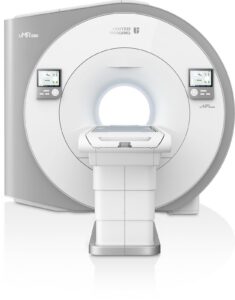
The center’s MRI uses a uMR680 machine with artificial intelligence technology that shortens scan times compared to conventional equipment. It makes rhythmic noises during the scan, which can be muffled with earplugs or headphones. You are never out of communication with the technologist.
Why does it matter to get both done at the same center?
Having both done at the same center matters because the images are compared within the same system, the radiologist accesses your complete history without you having to carry discs or plates, and the team knows your case from the first study.
What changes for you when you both go through San Juan MRI:
| A single pre-authorization. The medical plan covers both studies. | The radiologist directly compares CT & MR I on the same system, without waiting for a copy from elsewhere. |
| Creatinine free of charge. Available at the same center for those who require it before the contrast. | A single file. The entire case history compiled. A richer reading with each new image. |
Schedule your MRI or CT scan at San Juan MRI
When you schedule with San Juan MRI at (787) 721-7776 or through the website form, the team assists you with pre-authorization from your medical plan for either study, and both are done at the same center in Santurce without you having to move from one place to another.
What you’ll find in the center:
– uMR680 with artificial intelligence for MRI: shorter studies and wider aperture.
– Multi-detector spiral CT with age and weight-adjusted dose.
– Accreditation from the American College of Radiology (ACR) for both services.
– Companion allowed during the study.
– Creatinine test free of charge for those who require it before the contrast.
– Hours: Monday to Friday, 7am to 4pm.
– Operating since 1990, it is the oldest imaging center in Puerto Rico.
Frequently Asked Questions
What is the difference between an MRI and a CT scan?
A CT scan uses X-rays and is better at seeing bones, calcifications, and blood vessels; an MRI uses a magnetic field and is better at seeing soft tissues such as the brain, bone marrow, and organs.
When is an MRI used and when is a CT scan used?
MRI is ordered for soft tissue (knee, spine, brain, liver). CT is ordered for bones, blood vessels, bleeding, or for rapid imaging in emergencies.
Does the CT scan involve radiation?
Yes, low dose. At San Juan MRI, the dose is automatically adjusted by age and weight.
Does an MRI hurt?
No. It makes rhythmic noises during study, which can be mitigated with earplugs or headphones.
Which takes longer, a CT scan or an MRI?
The MRI. The CT scan takes only a few minutes; the MRI is more extensive because its sequences are longer.
Why did my doctor order a CT scan and not an MRI?
Because what you need to see are bones, vessels, bleeding, or a quick image; CT is better for those cases.
Can I have both tests done at the same center?
Yes. San Juan MRI offers MRI and CT scans at the same center, with only one pre-authorization from your health insurance plan.
Your doctor chose between a CT scan and an MRI based on what type of image they needed to answer their clinical question about your body, because each test is better at seeing different things. A CT scan uses X-rays and shows bones, calcifications, and blood vessels in detail in just a few minutes. An MRI uses a powerful magnetic field with radio waves, doesn’t use radiation, and shows soft tissues (brain, spinal cord, joints, abdominal organs) in detail that a CT scan can’t. Which one you had depends on what the doctor needs to see, not which is “better”: each is better for something different.
What is the difference between a CT scan and an MRI?
A CT scan uses X-rays and produces an image in just a few minutes; an MRI uses a powerful magnetic field with radio waves and takes longer. This technical difference is what determines which scan provides the best image for each part of your body.
| CT (Computed Tomography) | MRI (Magnetic Resonance Imaging) | |
| Technology | X-ray | Magnetic field + radio waves |
| Radiation | Yes, low dose (in San Juan MRI adjusted for age and weight) | It does not use radiation. |
| Duration | A few minutes | More extensive |
| Look better | Bones, calcifications, vessels, acute bleeding | Brain, spinal cord, joints, soft organs |
| Typical cases | Fracture, kidney stone, emergency, chest | Knee, spine, liver, suspected tumor |
The choice between one and the other is not a matter of preference. It’s a matter of physics: CT cannot see in the same detail as MRI, and MRI cannot match CT in quickly imaging bone or vasculature with active bleeding.
When your doctor orders an MRI
Your doctor orders an MRI when they need to see soft tissues: knee, shoulder or spine pain after a blow or injury, evaluation of the brain or spinal cord, suspected injury to ligaments or cartilage, or when they want to see an abdominal organ like the liver or pancreas in detail.
The most common cases that arrive at the center with an order for magnetic resonance imaging are:
– Knee pain after a fall or sports injury, to assess ligaments and menisci.
– Chronic back pain or suspected herniated disc, to examine discs, nerves and spinal cord.
– Persistent headache or suspected brain tumor, to examine brain tissue in detail.
– Abdominal evaluation of the liver, pancreas, or biliary tract when ultrasound was insufficient.
– Suspected soft tissue tumor , which needs to be characterized before any clinical decision.
When your doctor orders a CT scan
Your doctor orders a CT scan when they need a quick image or when they are looking for bones, calcifications, vessels, or bleeding: suspected fracture, acute abdominal pain, possible kidney stone, chest evaluation, search for pulmonary clots, or brain bleeding in an emergency.
Acute abdominal pain: In the emergency room, a CT scan can reveal in minutes whether there is appendicitis, kidney stones, bowel obstruction, or internal bleeding. It is the first study of its kind in this setting due to its speed.
Head trauma from an accident: CT rules out bleeding and fractures in less time than any other study, which defines the next clinical step.
Suspected lung cancer: A chest CT scan detects nodules and allows monitoring of their size and shape throughout treatment.
Oncological control: In patients with active cancer, central contrast CT assesses metastasis and response to treatment.
When do you need to have both tests done?
Sometimes you need both because each test answers a different question about the same problem. The most common example is a stroke: the CT scan is done first because it rules out active bleeding within minutes, and the MRI comes later to assess the damage to brain tissue in detail.
Other scenarios where both are done sequentially:
– Comprehensive oncological evaluation. The CT scan detects the lesion and measures its size; the MRI assesses whether it invades surrounding soft tissue.
– Severe trauma. CT rules out fractures and internal bleeding; MRI evaluates spinal cord or ligament injuries not seen on X-rays.
– Suspected abdominal tumor. Contrast-enhanced CT localizes the lesion; MRI characterizes it in detail.
In these cases, the two tests complement each other, they are not duplicated. Your doctor ordering the second test after the first does not mean the first one “was useless.”
What has radiation, what takes longer, and what does it feel like?
A CT scan uses low-dose X-ray radiation (which is automatically adjusted for age and weight at San Juan MRI) and takes only a few minutes. An MRI scan doesn’t use radiation but is more extensive because it uses a powerful magnetic field and longer imaging sequences. Neither is painful.
The center’s CT scanner is a multi-detector spiral machine that emits X-rays in fractions of a second, reducing exposure compared to a standard CT scanner. The computed tomography scan delivers the complete image in just a few minutes.
The center’s MRI uses a uMR680 machine with artificial intelligence technology that shortens scan times compared to conventional equipment. It makes rhythmic noises during the scan, which can be muffled with earplugs or headphones. You are never out of communication with the technologist.
Why does it matter to get both done at the same center?
Having both done at the same center matters because the images are compared within the same system, the radiologist accesses your complete history without you having to carry discs or plates, and the team knows your case from the first study.
What changes for you when you both go through San Juan MRI:
| A single pre-authorization. The medical plan covers both studies. | The radiologist directly compares CT & MR I on the same system, without waiting for a copy from elsewhere. |
| Creatinine free of charge. Available at the same center for those who require it before the contrast. | A single file. The entire case history compiled. A richer reading with each new image. |
Schedule your MRI or CT scan at San Juan MRI
When you schedule with San Juan MRI at (787) 721-7776 or through the website form, the team assists you with pre-authorization from your medical plan for either study, and both are done at the same center in Santurce without you having to move from one place to another.
What you’ll find in the center:
– uMR680 with artificial intelligence for MRI: shorter studies and wider aperture.
– Multi-detector spiral CT with age and weight-adjusted dose.
– Accreditation from the American College of Radiology (ACR) for both services.
– Companion allowed during the study.
– Creatinine test free of charge for those who require it before the contrast.
– Hours: Monday to Friday, 7am to 4pm.
– Operating since 1990, it is the oldest imaging center in Puerto Rico.
Frequently Asked Questions
What is the difference between an MRI and a CT scan?
A CT scan uses X-rays and is better at seeing bones, calcifications, and blood vessels; an MRI uses a magnetic field and is better at seeing soft tissues such as the brain, bone marrow, and organs.
When is an MRI used and when is a CT scan used?
MRI is ordered for soft tissue (knee, spine, brain, liver). CT is ordered for bones, blood vessels, bleeding, or for rapid imaging in emergencies.
Does the CT scan involve radiation?
Yes, low dose. At San Juan MRI, the dose is automatically adjusted by age and weight.
Does an MRI hurt?
No. It makes rhythmic noises during study, which can be mitigated with earplugs or headphones.
Which takes longer, a CT scan or an MRI?
The MRI. The CT scan takes only a few minutes; the MRI is more extensive because its sequences are longer.
Why did my doctor order a CT scan and not an MRI?
Because what you need to see are bones, vessels, bleeding, or a quick image; CT is better for those cases.
Can I have both tests done at the same center?
Yes. San Juan MRI offers MRI and CT scans at the same center, with only one pre-authorization from your health insurance plan.